
Key Takeaways
- An RIA custodian is more than an asset-safekeeping partner; it is a data infrastructure decision that can shape many downstream advisory workflows.
- Firms may want to evaluate custodial data-feed quality, API maturity, and reporting structures, as these can affect the efficiency of portfolio analysis and client communication.
- Beyond trading costs, firms may also weigh service-model fit for their growth stage, the economics of cash sweep programs, and the depth of technology integrations.
- For breakaway and transitioning advisors, a custodian's repapering process, ACATS and non-ACATS transfer support, and dedicated transition team are often cited as important evaluation factors.
- Multi-custodial operations offer flexibility but introduce data normalization and reporting complexities, and firms may benefit from a deliberate operational strategy to manage them.
Discussions around selecting an RIA custodian often center on a familiar set of criteria: trading costs, asset minimums, and the breadth of available investment products. These factors are important, but they represent only one part of a more complex operational decision. The custodian an advisory firm chooses also influences the quality, structure, and accessibility of the data that flows into many downstream workflows from portfolio analytics and transition modeling to proposal preparation and client-facing reporting.
An RIA's choice of custodian establishes a foundational layer of the firm's operational infrastructure. A partner with clean, well-structured data feeds and mature API connectivity can create a very different working experience for a firm's advisors and operations teams than one with fragmented exports that demand manual reconciliation. This guide moves beyond the standard comparison points to examine how custodial infrastructure shapes advisory workflows and which evaluation criteria may be worth weighing in a custodial decision.
What an RIA Custodian Does and Why the Role Matters
A qualified custodian is generally a financial institution that holds and safeguards client assets, including cash and securities, on behalf of advisory clients within the framework of the SEC custody rule. The qualified custodian framework stems from the Investment Advisers Act of 1940, and how its requirements apply to a specific firm is a question for that firm's compliance team and counsel. The regulatory framework generally separates the custody of client assets from the advisor's recommendation and communication role, although the structure of qualified custody arrangements can vary.
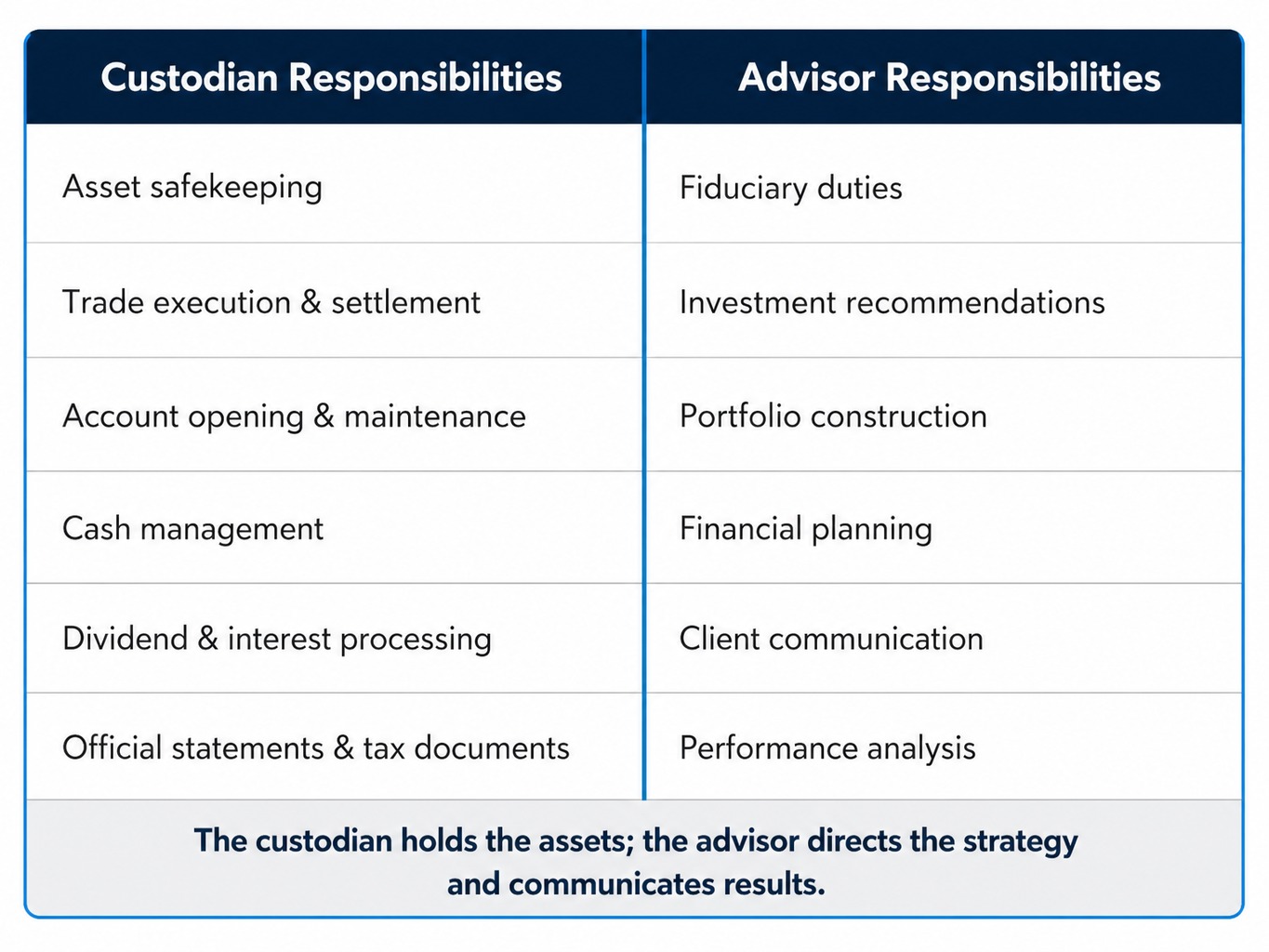
While the advisor and custodian work together, their roles are distinct.
- The Custodian Handles: Asset safekeeping, trade execution and settlement, client account opening and maintenance, cash management, dividend and interest processing, and the generation of official account statements and tax documents.
- The Advisor Handles: Fiduciary duties, investment recommendations, portfolio construction, financial planning, ongoing client communication, and performance analysis.
The diagram later in this section summarizes this division of responsibilities in a simplified side-by-side view intended to remain readable on smaller screens.
For instance, when a new client joins an advisory firm, the custodian is the entity that opens the account, executes the trades the firm's team places, and issues the monthly statements. The firm, as the advisor, determines the appropriate investment strategy and communicates the rationale and results to the client. Because the custodian sits at the center of much of the firm's transaction and position data, its operational capabilities have implications that extend far beyond trade settlement.
How Custodial Choice Shapes Comparative Portfolio Analysis and Client Communication
While most custodian comparisons focus on what happens at the custodian, the operational impact is often felt most acutely in the work that happens after the custodian generates data. Custodial data feeds can influence how efficiently an RIA analyzes portfolios, prepares transition scenarios, and produces materials used in client conversations. They are one input into that process, but firms may also rely on statement-based workflows when direct custodial data is not part of the acquisition process.
For a firm preparing for a dozen prospect and client review meetings in a week, the difference can be significant. If its custodial partner provided clean, structured data exports and reliable API access, the firm's portfolio analytics platform could ingest that information with minimal friction, keeping the path from data to insight short. If, however, the custodial data required manual downloads, reformatting in spreadsheets, and manual re-entry into other systems, preparation time for each meeting could expand, advisor capacity could shrink, and the risk of data-entry errors could grow.
Custodial Data Feeds and Their Effect on Analytical Workflows
The format, completeness, and reliability of custodial data exports can vary meaningfully, from the fields a file includes to how consistently it arrives. Where those exports fall short, advisors or operations teams may need to process data manually before it can be used for analysis.
Alternative investments are one area where classification gaps can surface. If a new custodian's data feed classified all alternative investments under a single generic category, the downstream presentation could still depend on the analytics platform's security master, normalization logic, and classification framework. In some cases, private credit, private equity, and real assets may be grouped into one line item on a client report unless the platform or operations team applies a more granular mapping approach.
The completeness of cost-basis information is another critical factor. Not all custodians return cost-basis data at the same level of specificity; some provide aggregate cost per position, while others deliver tax-lot-level detail with acquisition dates. Cost-basis availability can also depend on the asset type, the account's history, and the information transferred from a prior custodian or account. These differences can affect whether downstream analytics can model the tax consequences of a proposed reallocation without requiring supplemental client documents.
Read more: Automation in Wealth Management: Why Half-Automated Workflows Can Create More Risk Than Manual Ones
Multi-Custodial Operations and Reporting Complexity
Many firms adopt a multi-custodial strategy for sound business reasons, including accommodating advisor preferences after a merger, accessing specialized products, or providing clients with more choice. While this approach offers flexibility, it also introduces operational complexity, particularly around data aggregation and reporting.
Each custodian may classify the same asset type differently, use different default methods for selecting which tax lots are sold, or structure its data exports in incompatible formats. This doesn't mean multi-custodial operations are inherently inefficient, but it does mean the firm's reporting and reconciliation infrastructure plays a larger role in normalizing these differences to produce a consistent household view. It's important to distinguish between classification differences, which affect how holdings are categorized in reports, and transaction or pricing discrepancies, which can affect performance calculations. Identifying which type of difference is at play is one consideration when firms design their reconciliation workflows.
Evaluation Criteria That Often Receive Limited Treatment in Custodian Comparisons
Trading costs, AUM minimums, and brand recognition are well-covered in most RIA custodian comparisons. However, several other dimensions can also have a meaningful impact on an RIA's day-to-day operations and long-term scalability. Data quality is one of these dimensions, since gaps in a custodian's data feed tend to surface as downstream friction in operations rather than in trading. For firms evaluating custodians, this operational impact is one reason to weigh data quality alongside cost, particularly when the firm relies on separate analytical tools to turn custodial data into structured, client-ready analysis.
Service-Model Fit at Different Growth Stages
The service model a custodian offers, from a centralized call center to a dedicated relationship team, can be a critical factor in an RIA's experience. A firm in its early years might prioritize a custodian with low minimums, a responsive general service desk, and a simple digital onboarding process. As that firm grows, however, its needs may evolve.
A larger, more complex practice might begin to value a dedicated service team, where a consistent group of professionals understands the firm's specific operational needs. Access to institutional share classes, more sophisticated block trading and allocation capabilities, and a relationship manager who can act as an internal advocate become more important. Evaluating a service model can involve projecting the firm's needs several years into the future (two to five years is one illustrative horizon) rather than solving only for today's requirements. A model that feels efficient for a firm managing $100M may feel constraining for one approaching $1B.
Read more: Operational Visibility for Wealth Management Growth | VRGL
Cash Sweep Program Structures and Revenue-Sharing Transparency
How a custodian handles uninvested client cash is a component of the relationship that can receive less attention than pricing. Custodians use different structures for their cash sweep programs, including depositing cash at affiliated or third-party banks or sweeping it into money market funds. The yield clients receive, the compensation the custodian earns from those arrangements, and the related disclosures can vary meaningfully.
During due diligence, firms may want to ask for details on the current cash sweep program yield, how that yield is determined, how the custodian is compensated through the program, and what disclosures describe any related conflicts of interest. Where revenue-sharing applies, firms may also want to understand how that arrangement works and how it is disclosed. While it may seem like a minor detail, differences in sweep economics across a large client base with meaningful cash allocations can be material over time, affecting client outcomes and the overall economics of the custodial relationship.
Technology Integration Depth and API Maturity
A custodian's technology platform often does more than serve as a portal for placing trades. For many firms, it functions as a hub of a broader technology stack that includes CRM, portfolio management, financial planning, and reporting software. The depth of a custodian's integrations and the maturity of its API (Application Programming Interface) can significantly influence an RIA's ability to build a flexible, efficient, and interconnected technology environment.
When evaluating a custodian, firms may want to assess its integration with the portfolio management, reporting, and analytics platforms the firm uses or plans to adopt. Does the custodian offer single sign-on (SSO) to create a more unified advisor desktop? How open and well-documented is its API? An API that delivers position data quickly but omits key fields like asset sub-classification or original acquisition date can create more downstream work than a slower but more complete data file. Assessing a custodian's technology is partly about anticipating which tools a firm may want to integrate in the future. Understanding the broader RIA tech stack architecture can help firms identify where custodial connectivity gaps are most likely to appear.
What Breakaway Advisors and Transitioning Firms May Want to Evaluate
For an advisor breaking away from a wirehouse or an established RIA switching its primary custodial relationship, the evaluation process takes on additional dimensions. In these scenarios, the custodian's transition support infrastructure can carry weight alongside its ongoing service quality and pricing.
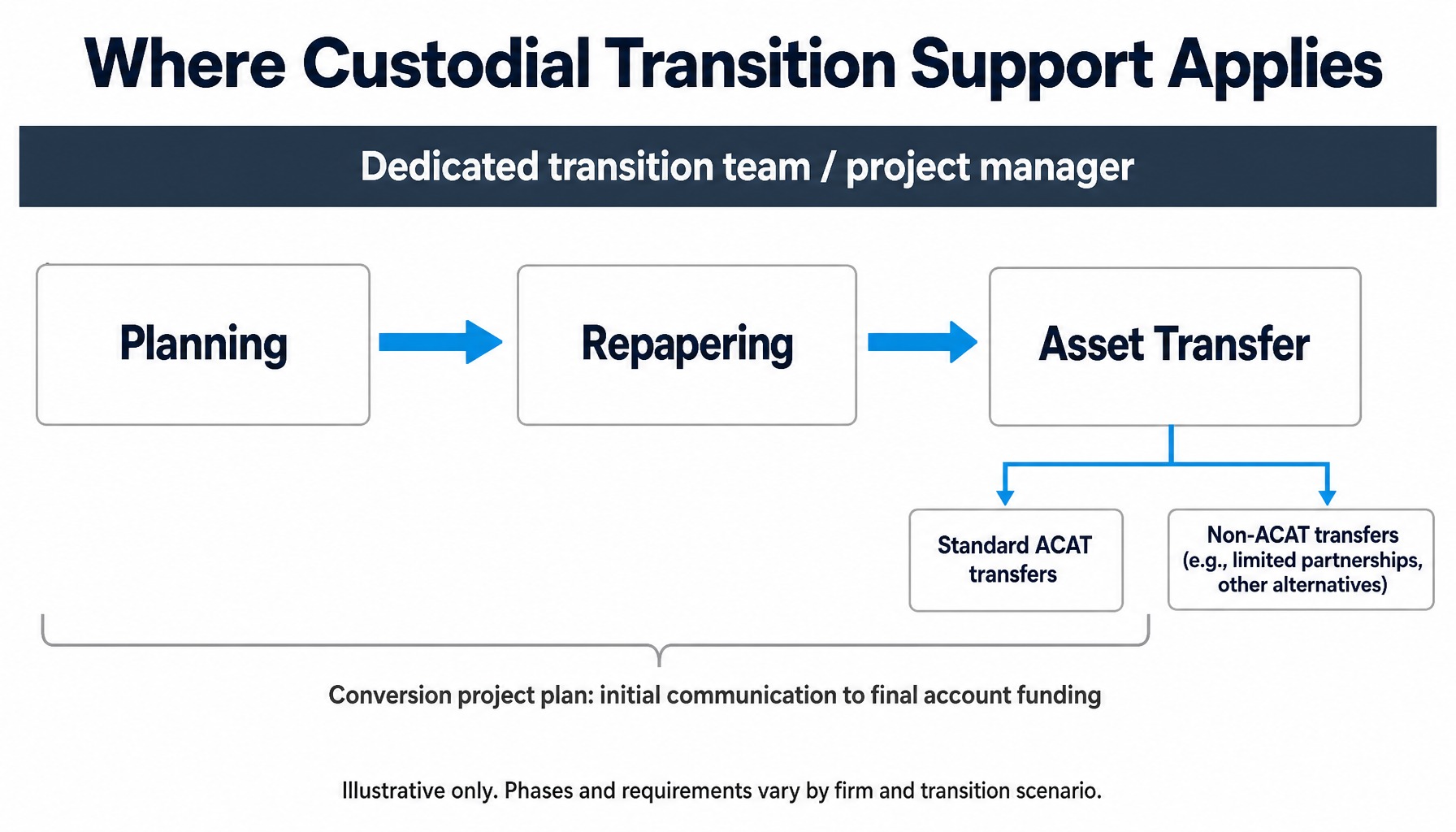
Transitions are often described in industry commentary, rather than in a specific study cited here, as depending as much on client trust and operational execution as on technology. The custodian's ability to support a smooth transition can be a meaningful differentiator. Key areas to evaluate include:
- Dedicated Transition Support: Does the custodian provide a dedicated transition team or project manager to guide the firm through the process?
- Repapering Process: How does the custodian support the significant administrative task of completing new client account paperwork? Do they offer digital tools or other resources to streamline this workflow?
- ACATS and Non-ACATS Transfer Processes: How experienced is the custodian in handling standard Automated Customer Account Transfer Service (ACATS) transfers, and when needed, non-ACATS transfer processes for certain alternative investments, limited partnerships, or other assets that may not move through ACATS?
- Conversion Project Plan: Will the custodian work with the firm to develop a realistic, structured timeline for the entire conversion, from initial communication to final account funding?
When a breakaway team moves hundreds of client accounts, a custodian with a well-defined process, experienced personnel, and a clear project plan can help mitigate the operational risk and client-facing disruption inherent in such a move. That support can also reduce the administrative logistics the advisors manage directly during the transition. Some firms navigating this process also use a dedicated client transition and proposal management platform to support the analytical side of the move.
How Comparative Portfolio Analysis Connects to Custodial Data Quality
The central argument of this guide is that an RIA custodian is an infrastructure partner, and the quality of that infrastructure shapes the work of advice. Because portfolio data informs the analysis advisors prepare when bringing on new clients, firms that are single-custodian, multi-custodial, or transitioning clients from a legacy platform can benefit from a repeatable acquisition workflow that moves from raw portfolio data to structured, comparable insights. For firms evaluating tools for this step, consistency across custodial sources is a common consideration.
VRGL supports this workflow through AI-powered statement extraction from supported investment statements, followed by five-pillar Comparative Portfolio Analysis across performance, risk, diversification, taxes, and fees, tax transition analysis, and branded proposals that help advisors present findings clearly. Discovery and fact-finding remain with the advisor; once a prospect's statements have been gathered, VRGL's analytical workflow begins. Rather than relying on direct custodial feed integration for this step, VRGL extracts and organizes data from supported investment statements so advisors can work from a structured analytical view.
- Normalize Data: Extract and organize holdings data from supported investment statements into a single, consistent analytical framework.
- Accelerate Insight: Move from prospect statements to a structured view of a current portfolio more efficiently, with less manual data entry.
- Present Comparisons: Generate branded proposals and reports that describe the characteristics of a client's current portfolio and compare it to a proposed strategy.
VRGL helps firms standardize their acquisition workflow , establishing a shared analytical and presentation baseline that can reduce manual friction for advisors. VRGL supports the analytical and presentation process; it does not provide investment recommendations, handle custody, open accounts, or execute ACATS transfers.
See how VRGL supports your acquisition workflow across custodial sources
Conclusion
Selecting an RIA custodian is a foundational decision with long-term operational consequences. While trading costs, platform features, and AUM minimums are valid comparison points, they do not tell the whole story. Custodial data infrastructure can also influence how efficiently and consistently a firm analyzes portfolios, prepares for client conversations, and communicates its value.
By expanding the evaluation framework to include criteria like data-feed quality, API maturity, service-model fit, cash sweep economics, and transition support, firms can make a more informed choice. As advisory firms continue to grow and adopt more sophisticated analytical tools, the connection between custodial data infrastructure and the efficiency of downstream advisory workflows is likely to remain an important consideration.
This article is for informational purposes only and does not constitute investment, legal, tax, or compliance advice. Your firm is responsible for its own due diligence and compliance with applicable regulations.
Frequently Asked Questions
1. How does custodial pricing differ between basis-point fees and per-trade ticket charges?
Custodial pricing can include asset-based fees, per-trade ticket charges, per-account fees, and flat platform charges, but that is only part of the picture. Firms may also want to evaluate cash sweep economics, asset servicing fees, transaction charges, and other revenue arrangements through which the custodian is compensated. How these costs and economics apply depends on factors such as trading activity, asset mix, cash balances, and the services the firm and its clients use.
2. Can an RIA use more than one custodian at the same time?
Yes, many RIAs establish relationships with multiple custodians to gain flexibility, accommodate client or advisor preferences, or access specialized products. However, operating a multi-custodial practice introduces additional complexity around data aggregation, reporting consistency, and operational workflows, which are important considerations for firms evaluating this strategy. A similar aggregation question arises with held-away assets, the accounts clients keep at other institutions, which firms often want reflected in a consolidated household view.
3. How do custodians differ in their support for alternative investments and private placements?
Custodial support for alternative investments varies significantly. Some larger custodians have dedicated alternative investment teams and established workflows for handling subscription documents, capital calls, and distributions for assets like private placements or limited partnerships. Others offer limited or no support for these non-standard asset types, a key diligence item for firms with significant alternative allocations.
4. What due diligence questions can an RIA ask before signing a custodial agreement?
Firms may want to inquire about best-execution practices and reporting, business continuity and disaster recovery plans, information security controls, and details on SIPC and any excess insurance coverage. It is also common to ask for specifics on data export formats, API availability, and the economics of the custodian's revenue-sharing and cash sweep programs. Reviewing a custodian's FINRA BrokerCheck record can also be part of the evaluation.
5. How do custodians handle in-kind versus liquidated account transfers?
During an ACATS transfer, positions that the receiving custodian can hold are typically moved in-kind, meaning the securities transfer without being sold. However, positions the new custodian does not support, such as certain proprietary mutual funds, may need to be liquidated before the transfer, which can create taxable events for the client. The specifics depend on the custodians, account types, and securities involved.
6. What custodial capabilities may matter most for enterprise RIA firms with multiple offices?
Enterprise-level RIAs may prioritize a custodian's capabilities around block trading and allocation, sub-accounting (recordkeeping that tracks each client's share of pooled fund positions), and centralized reporting tools that provide visibility across multiple advisor teams. The custodian's service structure, whether it provides dedicated relationship management at the firm level or the advisor level, can also affect how consistently the firm experiences support across its offices.